
  877.543.5970 ext. 102   christopher@atlasindicators.com
  •  
  •   Client Login

  • Home
  • About 
    • Our Team
    • Our Philosophy
    • Our Process
  • Our Services 
    • Our Services
    • Investments
    • Insurance
    • Retirement Planning
  • Resources 
    • Useful Websites
    • Financial Calculators
    • Video Library
  • Blog
  • Contact

    You are here

  1. Home
  2. Blogs
  3. Artificial Independence

Artificial Independence

Submitted by Atlas Indicators Investment Advisors on April 29th, 2026
Two things are hot topics in Washington D.C. these days: artificial intelligence (AI) and the Federal Reserve. Just Tuesday an announcement was made about the newest Anthropic model, Mythos, getting into the hands of nefarious actors. This is an AI model which has discovered many cybersecurity vulnerabilities across many platforms which were previously unknown. Also on Tuesday, Federal Reserve Chair nominee, Kevin Warsh, testified in front of the Senate confirmation hearing that he would not be a sock puppet if confirmed for the role but would instead maintain independence.


At its most fundamental level, artificial intelligence is really a sophisticated algorithm; a complicated set of rules that churn out answers to various queries. Couldn’t something like this be developed for interest rate policies? After all, we’re already hearing AI is taking over entry-level white-collar jobs. Why shouldn’t interest rate policy makers suffer a similar fate?


As it turns out, Artificial Independence has been proposed, studied, followed, and tossed into the circular file at the Eccles Building. John Taylor is an American economist and professor at Stanford University, known for his work on monetary policy. He introduced his set of rules known as the Taylor Rule in 1993 in a paper called “Discretion versus Policy Rules in Practice.” He wanted a simple rule that linked interest rates with two things: inflation and how well the economy is performing relative to its potential (i.e., the output gap).


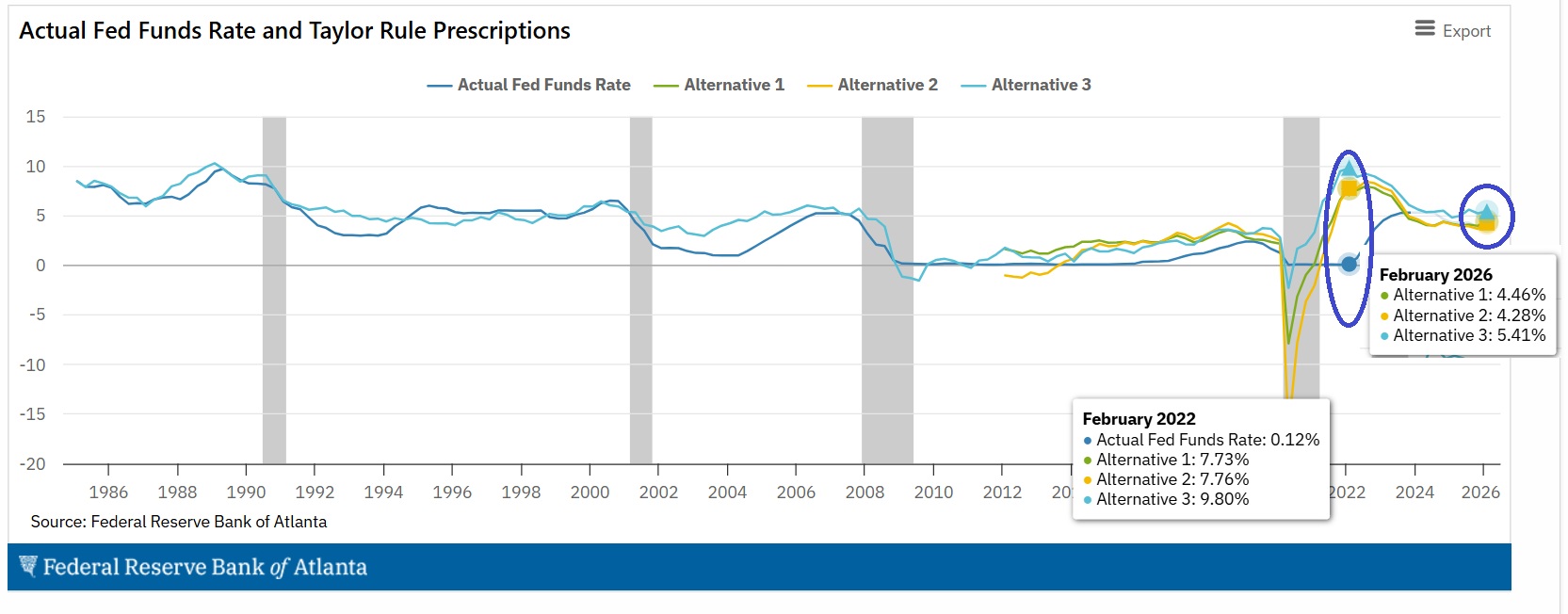
Above is a chart from the Federal Reserve Bank of Atlanta (click here to see the article).  It shows various versions of the rule and where each version would place the overnight Fed Funds Rate as of February 2026. As you can see, all of them suggest monetary policy was too loose less than two months ago. Currently, the Fed Funds Rate target is between 3.5% and 3.75%, shy of the lowest mark of 4.28% from various calculations of the Taylor Rule.


To say following this rule would have produced better/worse results is counterfactual. We’ll never know. But one thing we can see is that February 2022 when inflation was the highest in a generation and the Fed was keeping its overnight lending rate nailed to the floor, these models called for the rate to be between 7.73% and 9.8%. Rules like the Taylor Rule do not eliminate uncertainty, but they do expose errors and impose discipline. If policy makers want to maintain independence, they may want to impose rules that support this notion.

Tags:
  • Central Bank
  • Fed Funds Rate
  • Federal Reserve
  • Inflation
  • Monetary Policy
  • Taylor Rule

Book a Meeting

Tell a Friend

Looking to learn more?

Get in touch today

Contact Us

Additional info

  • Sitemap
  • Legal, privacy, copyright and trademark information

Contact info

  •   560 W Foothill Pkwy, Corona, CA 92882
  •   877.543.5970 ext. 102
  •   christopher@atlasindicators.com

Investment Advisory Services offered through Independent Advisor Representatives of Cooper McManus, a Registered Investment Adviser Securities offered through Registered Representatives of Cambridge Investment Research, Inc., a broker-dealer, member FINRA/SIPC, to residents of: CA, HI, MA, MT, OR, PA, and TX. Cambridge and Atlas Indicators Investment Advisors, Inc. are not affiliated.​

Cambridge's Form CRS (Client Relationship Summary)

Please see the following for our services disclaimer: Asset Allocation: Diversification seeks to reduce the volatility of a portfolio by investing in a variety of asset classes. Neither asset allocation nor diversification guarantee against market loss or greater or more consistent returns. Asset allocation does not guarantee a profit or protection from losses in a declining market. Precious Metals: Investments in precious metals such as gold involve risk. Investments in precious metals are not suitable to everyone and may involve loss of your entire investment. These investments are subject to sudden price fluctuation, possible insolvency of the trading exchange and potential losses of more than your original investment when using leverage. Real Estate: Specific-sector investing such as real estate can be subject to different and greater risks than more diversified investments. Declines in the value of real estate, economic conditions, property taxes, tax laws, and interest rates all present potential risks to real estate investments. Diversification: Diversification seeks to reduce the volatility of a portfolio by investing in a variety of asset classes. Neither asset allocation nor diversification guarantee against market loss or greater or more consistent returns. Index: An investor cannot invest directly in an index.

This site is published for residents of the United States and is for informational purposes only and does not constitute an offer to sell or a solicitation of an offer to buy any security or product that may be referenced herein. Persons mentioned on this website may only offer services and transact business and/or respond to inquiries in states or jurisdictions in which they have been properly registered or are exempt from registration. Not all products and services referenced on this site are available in every state, jurisdiction or from every person listed.

© 2026 Atlas Indicators Investment Advisors. All rights reserved.

Website Design For Financial Services Professionals