
  877.543.5970 ext. 102   christopher@atlasindicators.com
  •  
  •   Client Login

  • Home
  • About 
    • Our Team
    • Our Philosophy
    • Our Process
  • Our Services 
    • Our Services
    • Investments
    • Insurance
    • Retirement Planning
  • Resources 
    • Useful Websites
    • Financial Calculators
    • Video Library
  • Blog
  • Contact

    You are here

  1. Home
  2. Blogs
  3. Rates of Change

Rates of Change

Submitted by Atlas Indicators Investment Advisors on May 25th, 2026
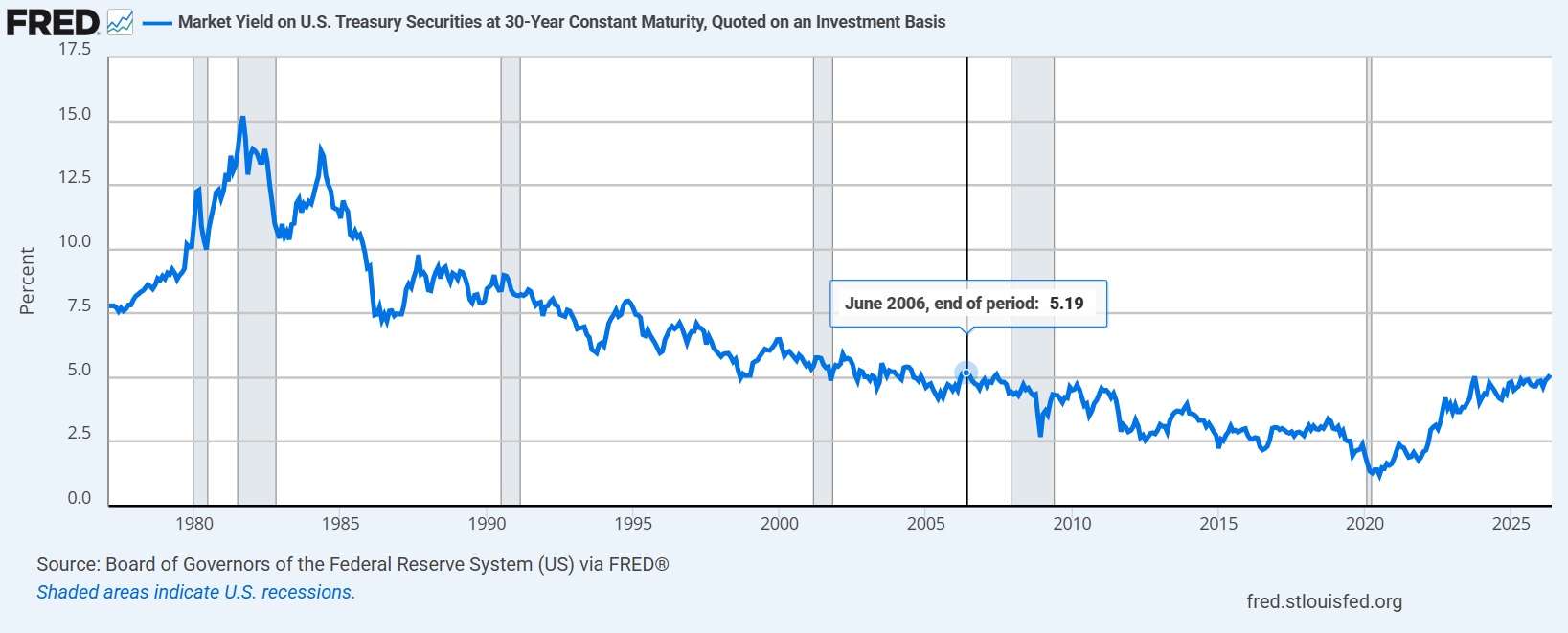
This was potentially a telling week for interest rates in America on the extreme ends of the yield curve. Way out on the right of the curve is the 30-year treasury bond. Its yield is what lenders to the American government can expect to be paid for the long-term loan. It reached 5.18% earlier this week, the highest level since 2006 (see chart above). That came on the heels of a rapid uptick to 5.00% on May 14th that pushed to 5.12% on May 15th. This is not just a crossing of an arbitrary threshold but could also be a sign of future borrowing costs across the American economy.


There were signals for the left-hand or short-term side of the yield curve as well this week. The Federal Open Market Committee (FOMC) released their most recent meeting minutes on Wednesday. This meeting was held April 28-29 and concluded with the FOMC leaving the overnight lending rate banks charge each other unchanged. It also, however, produced the highest level of dissent within the committee since October 1992 as four officials voted against the majority decision.  Additionally, a majority of participants highlighted that “some policy firming would likely become appropriate if inflation were to continue to run persistently above 2.0%.” According the Fed’s preferred measure of inflation (the core PCE Price Index), the year-over-year change has not been under this target since February 2021.


Vulnerabilities always exist in markets and economies, but the Fed suggested that some of them are notable at this time. They believe that leverage in the financial markets has notable risks as hedge fund leverage remained high as did leverage at life insurance companies. By contrast, they were less concerned about exposures within the banking system.


Change could be coming for the yield curve driven by two forces. First, markets price long-dated treasury bonds as federal government’s borrowing costs are reaching territory not seen in nearly two decades. This could have knock-on effects for other borrowers across the economy which might accumulate quietly for a while and then suddenly be felt all at once. Simultaneously, policy makers are hinting at the potential need to push short-term rates higher, something which was unfathomable at the start of this year. This does not have to be awful news, however. The yield curve is not inverting, a condition which can often precede a recession. Instead, markets could be signaling that America’s economy remains strong enough to continue growing even as higher rates potentially loom on the horizon.

Tags:
  • FOMC
  • Friday
  • Inflation
  • Interest Rates

Book a Meeting

Tell a Friend

Looking to learn more?

Get in touch today

Contact Us

Additional info

  • Sitemap
  • Legal, privacy, copyright and trademark information

Contact info

  •   560 W Foothill Pkwy, Corona, CA 92882
  •   877.543.5970 ext. 102
  •   christopher@atlasindicators.com

Investment Advisory Services offered through Independent Advisor Representatives of Cooper McManus, a Registered Investment Adviser Securities offered through Registered Representatives of Cambridge Investment Research, Inc., a broker-dealer, member FINRA/SIPC, to residents of: CA, HI, MA, MT, OR, PA, and TX. Cambridge and Atlas Indicators Investment Advisors, Inc. are not affiliated.​

Cambridge's Form CRS (Client Relationship Summary)

Please see the following for our services disclaimer: Asset Allocation: Diversification seeks to reduce the volatility of a portfolio by investing in a variety of asset classes. Neither asset allocation nor diversification guarantee against market loss or greater or more consistent returns. Asset allocation does not guarantee a profit or protection from losses in a declining market. Precious Metals: Investments in precious metals such as gold involve risk. Investments in precious metals are not suitable to everyone and may involve loss of your entire investment. These investments are subject to sudden price fluctuation, possible insolvency of the trading exchange and potential losses of more than your original investment when using leverage. Real Estate: Specific-sector investing such as real estate can be subject to different and greater risks than more diversified investments. Declines in the value of real estate, economic conditions, property taxes, tax laws, and interest rates all present potential risks to real estate investments. Diversification: Diversification seeks to reduce the volatility of a portfolio by investing in a variety of asset classes. Neither asset allocation nor diversification guarantee against market loss or greater or more consistent returns. Index: An investor cannot invest directly in an index.

This site is published for residents of the United States and is for informational purposes only and does not constitute an offer to sell or a solicitation of an offer to buy any security or product that may be referenced herein. Persons mentioned on this website may only offer services and transact business and/or respond to inquiries in states or jurisdictions in which they have been properly registered or are exempt from registration. Not all products and services referenced on this site are available in every state, jurisdiction or from every person listed.

© 2026 Atlas Indicators Investment Advisors. All rights reserved.

Website Design For Financial Services Professionals