
  877.543.5970 ext. 102   christopher@atlasindicators.com
  •  
  •   Client Login

  • Home
  • About 
    • Our Team
    • Our Philosophy
    • Our Process
  • Our Services 
    • Our Services
    • Investments
    • Insurance
    • Retirement Planning
  • Resources 
    • Useful Websites
    • Financial Calculators
    • Video Library
  • Blog
  • Contact

    You are here

  1. Home
  2. Blogs
  3. Higher and Tighter

Higher and Tighter

Submitted by Atlas Indicators Investment Advisors on September 30th, 2026
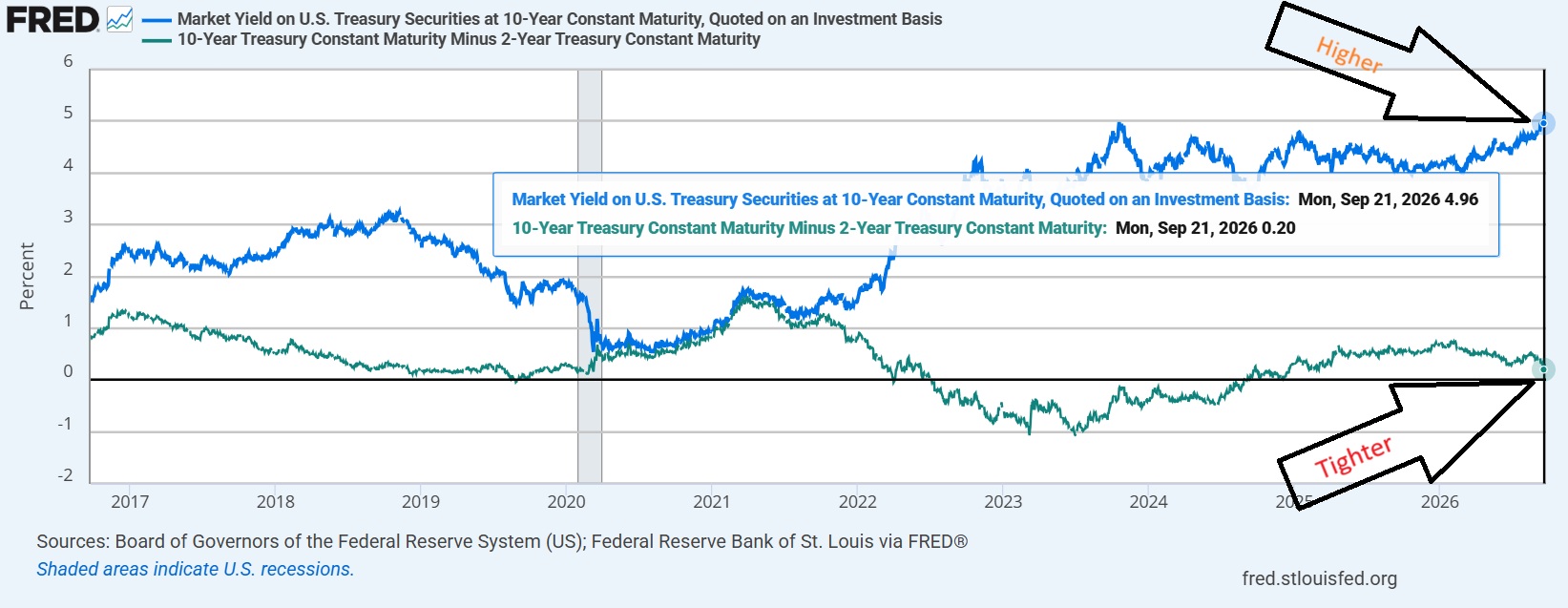
The yield curve is a picture of how much interest the U.S. government has to pay to borrow money over different periods of time. These loans can vary from just a few months to several decades. Typically, the rates rise as the time horizon for repayment increases. But that is not always the case. As recently as mid-2022 through mid-2024, the relationship between 2-year treasury notes and 10-year treasury bonds was reversed. While this type of inversion is typically a harbinger of difficult economic conditions ahead, a recession never materialized.


Today that relationship is in its typical pattern (i.e., it cost the U.S. government more to borrow for 10 years than 2 years). But there have been some interesting movements recently. With inflation elevated, and the Federal Reserve increasing the overnight lending rate last week, the trend for interest rates has been higher as lenders demand more protection from the rising cost of living. While rates have been moving higher, the difference between interest paid on a 10-year bond and a 2-year note has been getting tighter. For example, the difference between the two at the start of this year was roughly 0.70 percentage point (4.17% - 3.47%); today, it is closer to just 0.21 percentage point (4.97% -4.76%).


The observation Atlas finds most interesting today is what is driving this change. As you may have noticed, the rate change for the 2-year note has been greater than the rate change of the 10-year bond (1.29 percentage points vs 0.8 percentage point). This relationship is called a bear flattener; it happens when shorter yields rise faster than longer yields.


While the change from the start of this year until now is not exactly a canary in the coal mine for the economy, it warrants further observation. It may indicate markets expect further restrictive monetary policy (following the upward 2-year rate trajectory) coupled with less optimism about the future (following the less-steep upward 10-year trajectory). The kicker, of course, is that they are both higher which reflects America’s inflationary circumstances today. For now, the message from the bond market seems to be “higher and tighter.” Borrowing costs continue to rise, but investors are not exactly convinced that stronger growth lies beyond the horizon.

Tags:
  • Interest Rates
  • Yield Curve

Book a Meeting

Tell a Friend

Looking to learn more?

Get in touch today

Contact Us

Additional info

  • Sitemap
  • Legal, privacy, copyright and trademark information

Contact info

  •   560 W Foothill Pkwy, Corona, CA 92882
  •   877.543.5970 ext. 102
  •   christopher@atlasindicators.com

Investment Advisory Services offered through Independent Advisor Representatives of Cooper McManus, a Registered Investment Adviser Securities offered through Registered Representatives of Cambridge Investment Research, Inc., a broker-dealer, member FINRA/SIPC, to residents of: CA, HI, MA, MT, OR, PA, and TX. Cambridge and Atlas Indicators Investment Advisors, Inc. are not affiliated.​

Cambridge's Form CRS (Client Relationship Summary)

Please see the following for our services disclaimer: Asset Allocation: Diversification seeks to reduce the volatility of a portfolio by investing in a variety of asset classes. Neither asset allocation nor diversification guarantee against market loss or greater or more consistent returns. Asset allocation does not guarantee a profit or protection from losses in a declining market. Precious Metals: Investments in precious metals such as gold involve risk. Investments in precious metals are not suitable to everyone and may involve loss of your entire investment. These investments are subject to sudden price fluctuation, possible insolvency of the trading exchange and potential losses of more than your original investment when using leverage. Real Estate: Specific-sector investing such as real estate can be subject to different and greater risks than more diversified investments. Declines in the value of real estate, economic conditions, property taxes, tax laws, and interest rates all present potential risks to real estate investments. Diversification: Diversification seeks to reduce the volatility of a portfolio by investing in a variety of asset classes. Neither asset allocation nor diversification guarantee against market loss or greater or more consistent returns. Index: An investor cannot invest directly in an index.

This site is published for residents of the United States and is for informational purposes only and does not constitute an offer to sell or a solicitation of an offer to buy any security or product that may be referenced herein. Persons mentioned on this website may only offer services and transact business and/or respond to inquiries in states or jurisdictions in which they have been properly registered or are exempt from registration. Not all products and services referenced on this site are available in every state, jurisdiction or from every person listed.

© 2026 Atlas Indicators Investment Advisors. All rights reserved.

Website Design For Financial Services Professionals