
  877.543.5970 ext. 102   christopher@atlasindicators.com
  •  
  •   Client Login

  • Home
  • About 
    • Our Team
    • Our Philosophy
    • Our Process
  • Our Services 
    • Our Services
    • Investments
    • Insurance
    • Retirement Planning
  • Resources 
    • Useful Websites
    • Financial Calculators
    • Video Library
  • Blog
  • Contact

    You are here

  1. Home
  2. Blogs
  3. Bond Vigilantes

Bond Vigilantes

Submitted by Atlas Indicators Investment Advisors on September 30th, 2026
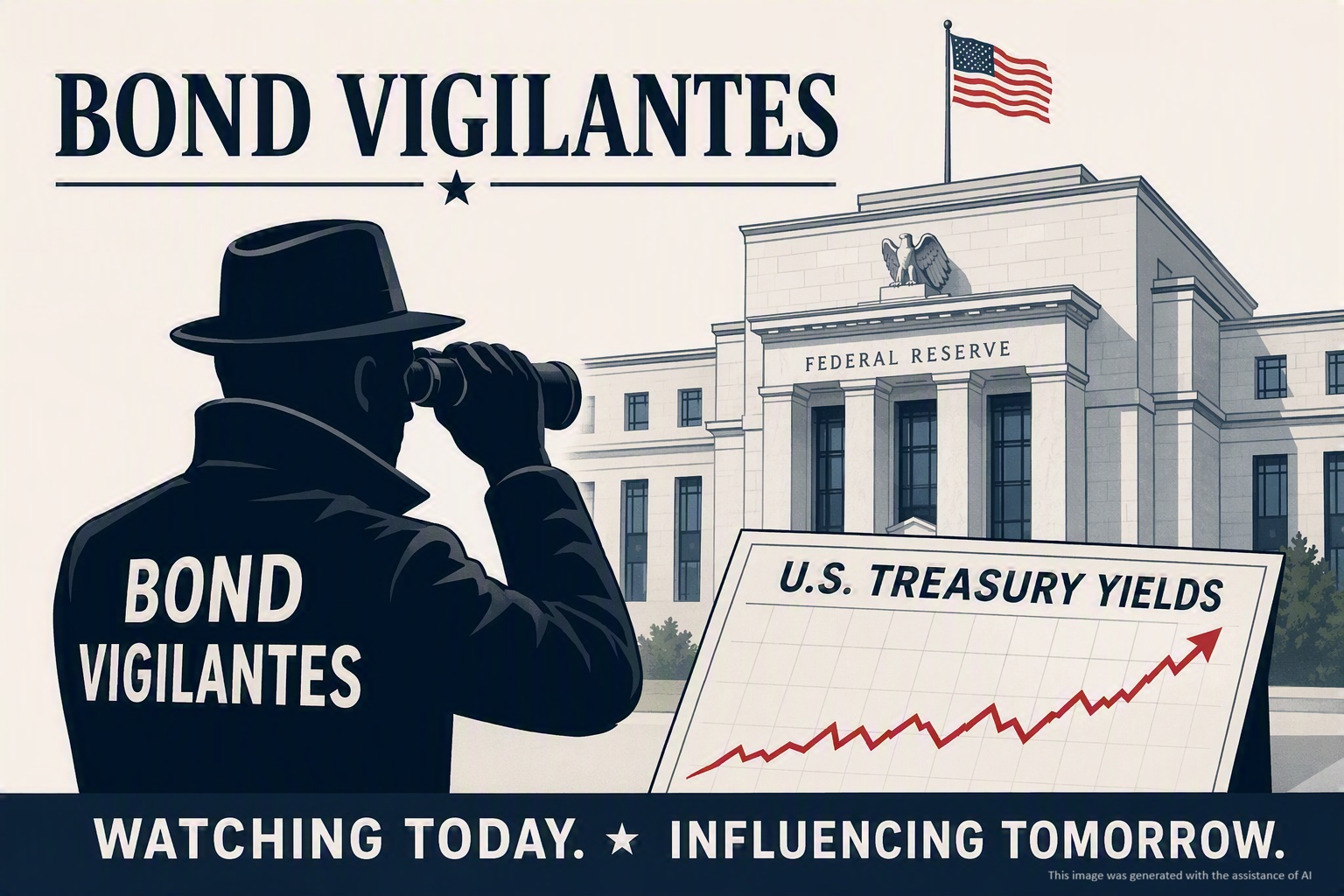
For you kids out there who may be too young to remember ancient American history, please allow me a moment to turn back to the days when Arkansan Bill Clinton was president. It was toward the end of the last century when he asked, “You mean to tell me that the success of the economic program and my re-election hinges on the Federal Reserve and a bunch of f***ing bond traders?”


Greenspan headed the Fed then, but he was not to blame for Bill’s angst. Robert Rubin, then Treasury Secretary, was helping design these programs by inaugurating expensive spending plans.  The bond markets reacted to the perceived increase in government debt by selling some of their holdings.  As you no doubt are aware, such selling simultaneously drives up interest rates.  A decade prior, the economist Ed Yardeni coined a term for these bond traders: Bond Vigilantes.


Today’s head of the Fed, Kevin Warsh, announced this July that the Board chose to leave rates unchanged in an effort to allow bond markets to react as seen fit without any hints of policy decisions that might influence trading.  A clever move, I’d say.  Essentially, he told bond traders to vote in part on deficit spending, thereby providing a clearer view of opinions regarding current spending policies.  He released the hounds and as he was speaking, interest rates began rising, presumably indicating at least some concern about deficit spending.  The bond vigilantes seemed primed to come roaring back.  We’ll see; it’s still early days.


The next question might be: How will the current administration react to increased spending, growing budget deficits and higher interest rate costs on the money our economy must pay to continue borrowing?  Back then, Bill saw the handwriting on the wall and quickly reversed course.  The record shows our government’s deficit improved for the following four years, he did get reelected, and the U.S. actually enjoyed a surplus during his second term.  That favorable outcome has not been repeated since. One of Clinton’s political advisors, James Carville, when musing about reincarnation, declared he wanted “to come back as the bond market.  You can intimidate everybody.”  Will it be enough?

Tags:
  • Bonds
  • Federal Reserve
  • Interest Rates
  • Treasury Department

Book a Meeting

Tell a Friend

Looking to learn more?

Get in touch today

Contact Us

Additional info

  • Sitemap
  • Legal, privacy, copyright and trademark information

Contact info

  •   560 W Foothill Pkwy, Corona, CA 92882
  •   877.543.5970 ext. 102
  •   christopher@atlasindicators.com

Investment Advisory Services offered through Independent Advisor Representatives of Cooper McManus, a Registered Investment Adviser Securities offered through Registered Representatives of Cambridge Investment Research, Inc., a broker-dealer, member FINRA/SIPC, to residents of: CA, HI, MA, MT, OR, PA, and TX. Cambridge and Atlas Indicators Investment Advisors, Inc. are not affiliated.​

Cambridge's Form CRS (Client Relationship Summary)

Please see the following for our services disclaimer: Asset Allocation: Diversification seeks to reduce the volatility of a portfolio by investing in a variety of asset classes. Neither asset allocation nor diversification guarantee against market loss or greater or more consistent returns. Asset allocation does not guarantee a profit or protection from losses in a declining market. Precious Metals: Investments in precious metals such as gold involve risk. Investments in precious metals are not suitable to everyone and may involve loss of your entire investment. These investments are subject to sudden price fluctuation, possible insolvency of the trading exchange and potential losses of more than your original investment when using leverage. Real Estate: Specific-sector investing such as real estate can be subject to different and greater risks than more diversified investments. Declines in the value of real estate, economic conditions, property taxes, tax laws, and interest rates all present potential risks to real estate investments. Diversification: Diversification seeks to reduce the volatility of a portfolio by investing in a variety of asset classes. Neither asset allocation nor diversification guarantee against market loss or greater or more consistent returns. Index: An investor cannot invest directly in an index.

This site is published for residents of the United States and is for informational purposes only and does not constitute an offer to sell or a solicitation of an offer to buy any security or product that may be referenced herein. Persons mentioned on this website may only offer services and transact business and/or respond to inquiries in states or jurisdictions in which they have been properly registered or are exempt from registration. Not all products and services referenced on this site are available in every state, jurisdiction or from every person listed.

© 2026 Atlas Indicators Investment Advisors. All rights reserved.

Website Design For Financial Services Professionals