
Evacuation Orders
Submitted by Atlas Indicators Investment Advisors on September 30th, 2026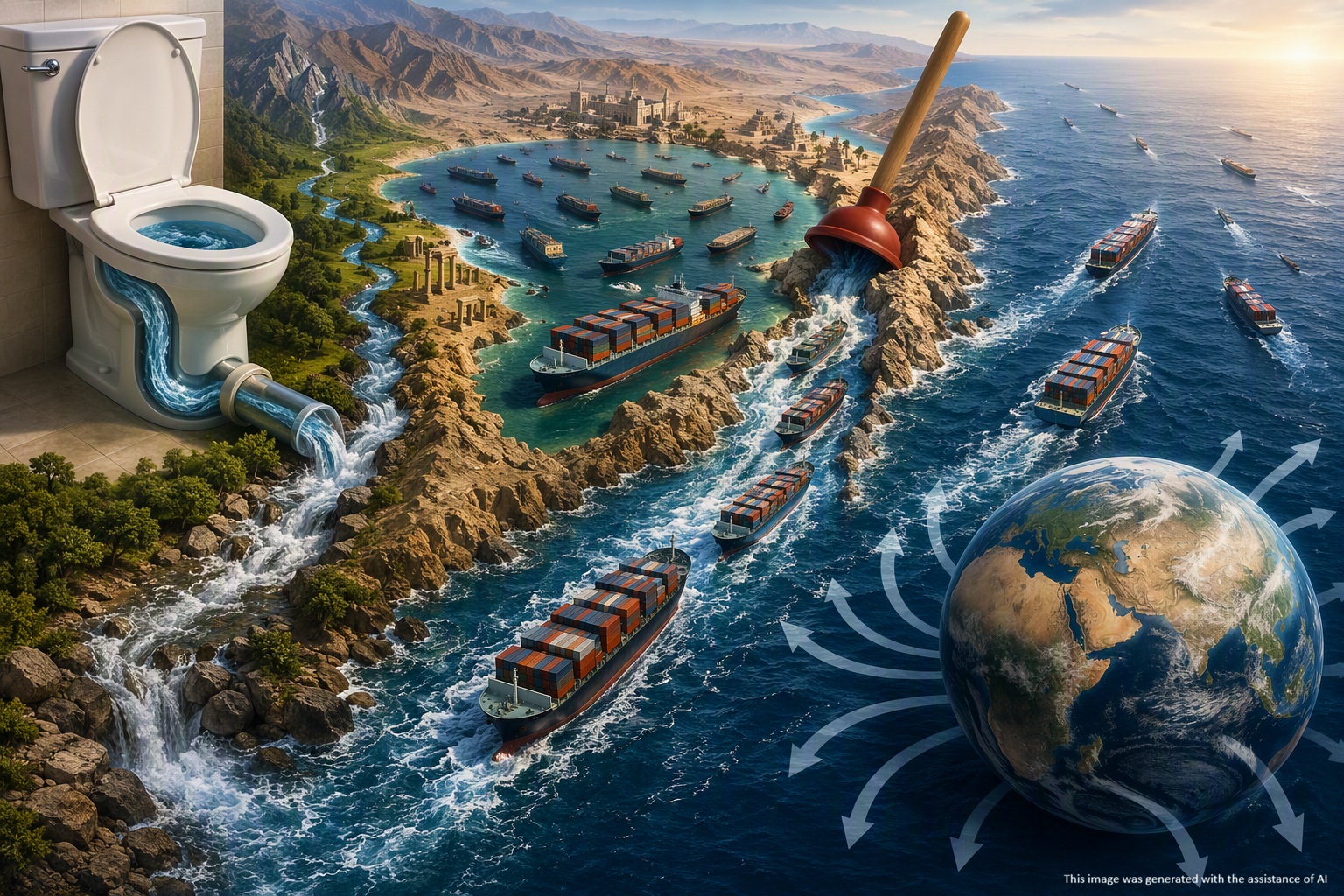
If you have done much traveling outside of the United States, you have probably experienced differences in toilet mechanisms. Specifically: different ways to flush. Humanity’s varied approaches to these porcelain conveniences demonstrate the flexibility of the human mind. However, in many places, a hole in the ground still functions to facilitate that same quotidian task of elimination.
The common American toilet is essentially a small basin designed to temporarily store water prior to transferring its contents to a larger body of water. In fact, the world‘s great water systems all share that trait in common. Small streams flow into large rivers; large rivers flow into seas. It all ends up in a vast ocean with currents constantly transporting everything around the world.
Which naturally reminds me of the Persian Gulf. In all recorded history, the Tigris and Euphrates rivers have carried continental contents into the Persian Gulf, that eponymously named body of water which has always hosted some of the world’s first and great empires. From here, water flows through the Straits of Hormuz, dumping into the Gulf of Oman, Arabian Sea, Indian Ocean and so on until its contents eventually become distributed worldwide.
Naturally, this also reminds me of the global shipping industry; I’m sure it does the same for you. Of course, much like the throne we humans in the western world visit with some frequency, it is itself generally too mundane to fret about. Our attention tends to focus more on its contents. Of relevance to today, those contents are the conveyances, the great ships which bring us our daily goodies. And lately this has been a big problem. If you have ever experienced a toilet which has been somehow blocked up, you will know exactly what I mean.
As I pen these thoughts, a political plunger of sorts has apparently opened this obstruction, allowing the massive buildup within the Persian Gulf to begin evacuation through the narrow Straits of Hormuz. An ultimatum has created a sixty-day window during which all the global transports which have been floating idly in the Gulf can be released to the world at large.
This is not something that can be done rapidly. What a nail biter! Can it be done? Can it be done in time? Will those same political winds that initiated this constipation turn yet again? Or must we all sit tight until a permanent solution is at hand. (by J R Capps, President Emeritus, Atlas Indicators)
